Applications for the 2027 course will open on September 2, 2026. Please check back then!
The School, the Centre, the town of Erice, and how to reach it.
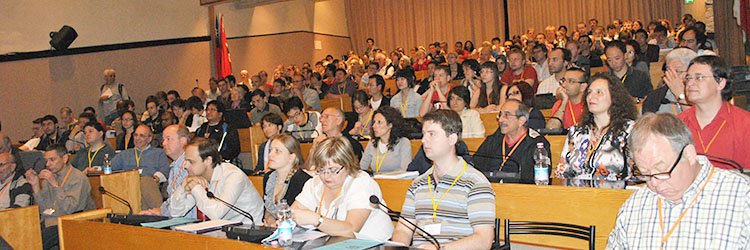
The International School of Crystallography (ISCoC) is a Scientific Session of the Ettore Majorana Foundation and Centre for Scientific Culture ETS (EMFCSC), devoted to promoting crystallographic knowledge in the scientific community. The idea of including Crystallography among the disciplines at the Majorana Centre was suggested by Professor Michael M. Woolfson (FRS, York University, UK) to Lodovico Riva di Sanseverino (Bologna University) in 1972. The School was officially started in 1974 (Prof. Michael Woolfson was also the Scientific Director of this very first Course on Direct Methods), under the scientific direction of Nobel Laureate Dorothy Hodgkin, and since then courses have been organized nearly every year. Some of them became "pillars" for serial meetings that marked the most relevant contributions and the exciting progress within these disciplines. In 1978 the scientific direction of the School was assumed by Professor Sir Tom Blundell, FRS (Cambridge University, UK). Topics cover the most current trends in structural sciences, from methods to applications, and are often suggested by scientists in the different areas.
The Director of each individual course is nominated by the ISCoC scientific director, and is responsible for selecting one or more co-directors, inviting the lecturers and planning the scientific program. Although usually one topic is selected each year, under special circumstances two crystallographic courses can be run simultaneously. The Director and co-directors are assisted by an Organizing Committee which includes the Executive Secretary (currently Dr. Annalisa Guerri), the School Treasurer (currently Prof. Paola Spadon) and an IT team (currently led by Erin Davis and Fred Boyle). In addition, local assistance during the Course is provided by a team of "Orange Scarves".
Attendance to the ISCoC is by application only and the final selection is made by the course scientific directors and the members of the Organizing Committee. Both scientific qualification and country of provenance play a role in the final selection process. The ISCoC strives to have the most geographically diverse student body possible, to enable and facilitate international collaborations. For the same reason, lecturers and students are encouraged to spend the full period of the course in Erice to optimize the person-to-person exchange of ideas and expertise.
Each course's support comes from attendees' fees, international grants, and local and international sponsors. As it was originally intended, the school aims to offer as many students as possible the possibility to come at reduced or no cost.
Each year at the end of the school, a link to a questionnaire is emailed to all participants. Responses to the questionnaire have proven invaluable in helping the organizing committee improve the logistics as well as the course organization.
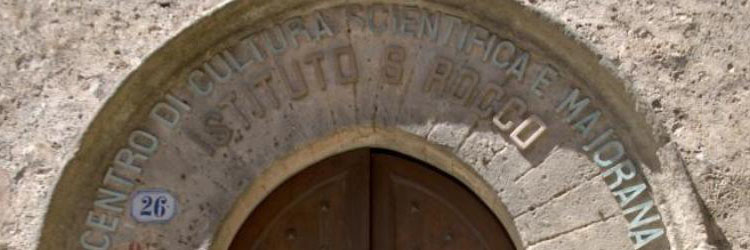
The ISCoC is hosted by the Ettore Majorana Foundation and Centre for Scientific Culture ETS, which organizes hundreds of international schools each year within beautifully restored medieval buildings in Erice.
Go to the EMFCSC website for more information about the Centre.
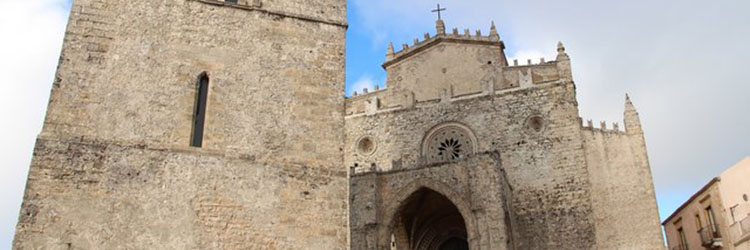
Erice is a small town at the extreme north-west corner of Sicily, on the top of a mountain (751 m above sea level) about 12 km from the seaside and 96 km from Palermo.
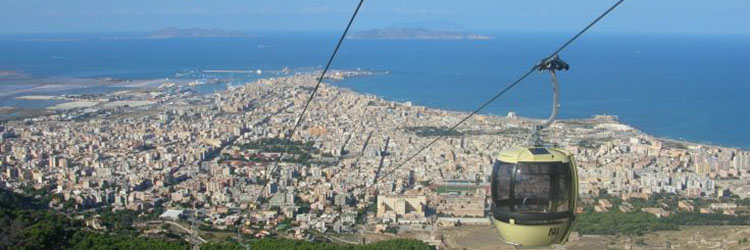
The town overlooks the city of Trapani and the low western coast towards Marsala. Monte Cofano and Capo San Vito, to the north-east, and the Aegadian Islands on Sicily's north-western coast are also visible from the town.
Erice originated as a settlement of the Elymians, a population originally from Asia Minor which arrived in Sicily and settled some of the island's western regions around 1200 BC. During the same period the Sicels colonised the northeastern part of the island; both coexisted with the native Sicanians. During the Greek domination most of the Elymians, including those of Segesta, assimilated culturally with the Greeks. Evidence suggests that the Elymians of Eryx, however, assimilated more readily with the Punic culture of the Carthaginians. Erice was known in antiquity as Eryx, and was famous throughout the Mediterranean for the temple of Venus Erycina, which grew out of a local Greek cult of Aphrodite. In the First Punic War, Eryx fell to the Carthaginians, and in 260 BC Hamilcar destroyed it. In the following years it was much contested by Greeks, Carthaginians and Romans. In 831 Eryx was conquered by the Arabs during their drive toward Palermo and other parts of western Sicily, and was renamed Gebel Hamed (Mountain of Hamid). It was ruled by Arabs until the Normans took over and in 1167 was renamed by the Normans Monte San Giuliano. This name remained until 1934, when the town was given back its original Latin name.
Because of its long history, the town has an exceptional number of palaces and churches, as well as convents and cloisters. Although the town is primarily medieval in character, ancient remains include cyclopean walls with Phoenician inscriptions and fragments of the celebrated temple.
There are two castles that remain in the city: Pepoli Castle, which dates from Saracen times, and the Venus Castle, dating from the Norman period, built on top of the ancient Temple of Venus, where Venus Erycina was worshipped. Ecclesiastical architecture is not absent from Erice. The principal church is the Chiesa Matrice (1314), with a portico from 1426 and a detached tower from 1312.
Due to its altitude, the town's weather is often much cooler than the valley, and Erice offers a much wanted relief during the hot days of summer. There are plenty of restaurants in which food typical of the Trapani province is served. The menus include pasta, lots of fish (octopus salad, stuffed sardines, grilled swordfish or tuna) and the occasional couscous dish, a salute to the city's Arab past. One of Erice's best known culinary characteristics is its pastries, which are tied to its history. The many churches in town have always been complemented by monasteries and convents, and the nuns in the convents made marzipan and baked cookies to support themselves.
Erice is an ancient settlement and another characteristic of the village are the narrow and steep streets that cross the town. They are made of limestone cobblestones that came from the nearby quarries of Custonaci. These cobblestones have become very slippery over the centuries, especially on rainy or... foggy days, so great care must be taken going around the place.
This aspect and some other structural features could make the access to the local facilities not straightforward to everyone. Please contact the local organizers if you would like to have more details on this matter.
On both arrival and departure days ONLY, transportation from/to Palermo and Trapani airport is arranged by the School free of charge. For travel to and from the airport on other days using the car service provided by the Centre, a fee of 100 - 150 Euro/car will be requested (depending on the airport to be driven to).