Scientific Report
62nd Course of the International School of Crystallography
“From Structural Biology to Structural Cell Biology with the aid of Machine Learning”
Erice, Italy, 29 May – 6 June 2026
Directors: Pietro Roversi, Helen Walden and Alex Caputo
General Summary
The 62nd Course of the International School of Crystallography was held at the Ettore Majorana Foundation and Centre for Scientific Culture in Erice, Italy, from 29 May to 6 June 2026. The Course brought together students, early-career researchers, lecturers and workshop leaders from academia and research infrastructures to explore the rapidly evolving landscape of structural biology and its transition towards Structural Cell Biology.
The scientific programme was designed around a central theme: how advances in machine learning, automation, integrative methods and high-resolution imaging are transforming our ability to study biological systems in increasingly native and physiologically relevant contexts. The Course featured 28 lecturers and six workshop streams covering crystallography, cryo-electron microscopy, cryo-electron tomography, integrative structural biology, biophysical methods, computational approaches and machine-learning applications across structural science.
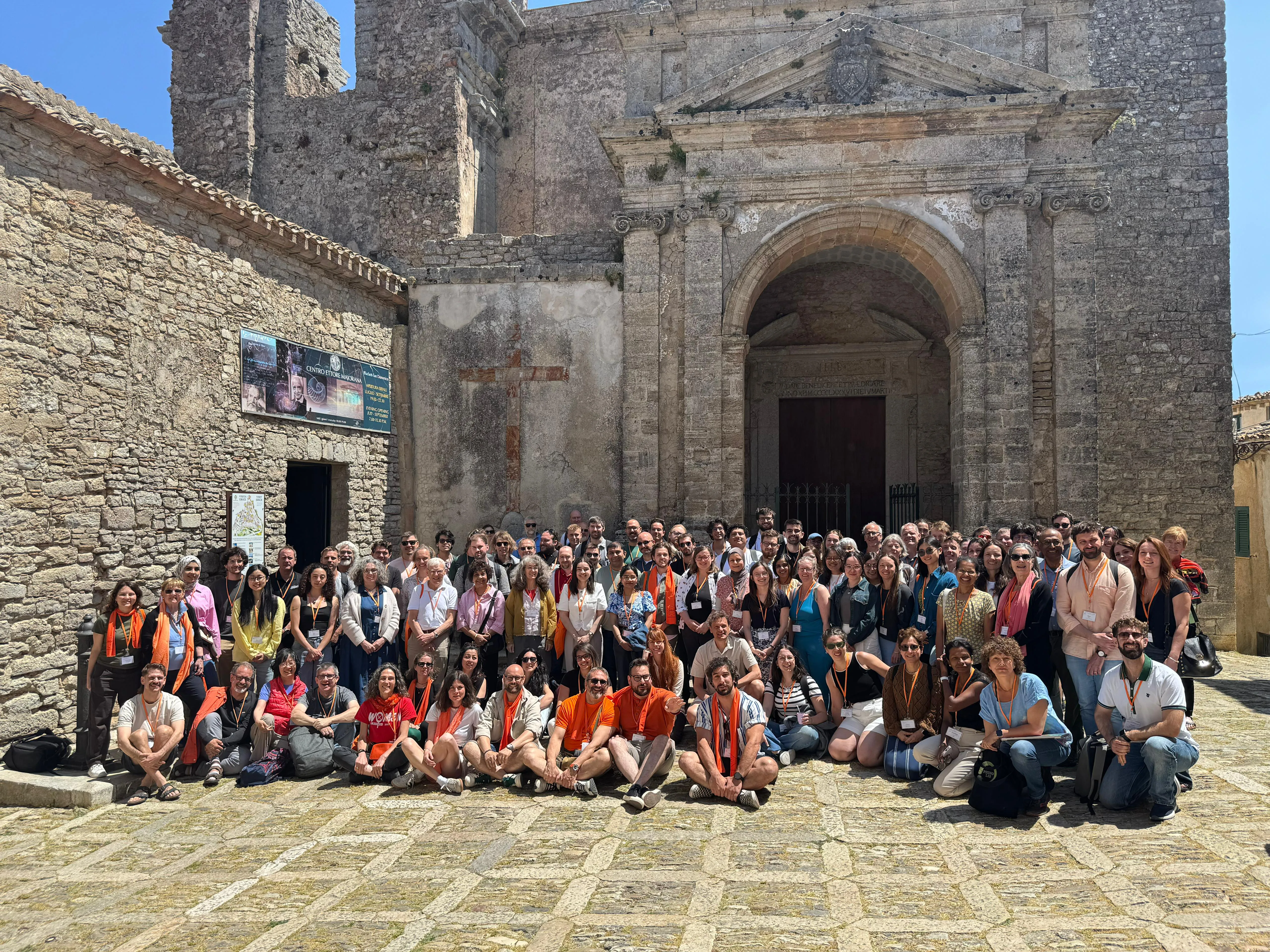
Participants were predominantly PhD students, postdoctoral researchers and early-career scientists, with additional representation from research infrastructures and industry. The Course maintained the traditional Erice emphasis on close interaction between students and lecturers, combining lectures, workshops, poster sessions, informal discussions and social activities.
Scientific Content
The programme was structured to guide participants through a conceptual journey from traditional Structural Biology towards Structural Cell Biology.
The opening lectures established this vision by examining a century of macromolecular structural science and the emergence of Structural Cell Biology as a discipline [Venki Ramakrishnan], the principles of integrative structural biology [Ioannis Skalidis], and the challenges of representing biological structures across multiple spatial scales [Monica Zoppè]. Participants were introduced to the growing role of data standards and interoperable repositories in supporting increasingly complex structural investigations [Brinda Vallat]. The landscape of Machine Learning algorithms and their uses gave the context and the principles guiding choices of structural biology software developers [Jola Mirecka].
A second set of lectures focused on complementary structural and biophysical methods. Small-angle X-ray scattering [Richard Gillilan], mass spectrometry [Perdita Barran], cross-linking mass spectrometry [Andrea Graziadei] and mass photometry [Weston Struwe] were presented as powerful sources of structural restraints and functional information that increasingly contribute to integrative structural models. Together, these lectures demonstrated how structural biology is moving beyond individual techniques toward the combination of orthogonal experimental observations.
The programme then examined diffraction-based methods and their theoretical foundations. Lectures covered crystal growth and automation [Alex Caputo], serial crystallography, [Emma Beale], neutron crystallography [Flora Meilleur] and the principles of likelihood-based inference [Airle McCoy].
Cryo-electron microscopy and cryo-electron tomography formed a major component of the programme. Lectures addressed the complete workflow from sample preparation and data collection to map interpretation, heterogeneity analysis and reconstruction of conformational trajectories. Particular attention was given to automation, machine-learning-assisted image processing and the growing accessibility of cryo-EM through national and international research infrastructures. Emerging developments in microscope design, real-time image analysis and automated data collection illustrated how computational approaches are increasingly embedded within experimental workflows.
The final part of the programme focused on biological systems in their native environments. Lectures on cryo-electron tomography, cellular imaging, integrative structural biology in native contexts, ciliary transport and cellular single-particle analysis demonstrated how structural methods are increasingly capable of addressing biological questions directly within cells and tissues. These developments illustrated the ongoing transition from the study of isolated macromolecules to the investigation of molecular processes in their physiological context.
Workshops
The Course included six workshops providing practical exposure to modern structural biology methodologies and software. These covered cross-linking mass spectrometry, molecular modelling and drug-design platforms, crystal structure determination with CCP4, cryo-electron tomography workflows in CCP-EM and cryo-ET reconstruction and analysis. Each workshop was repeated twice to maximise participation and provide opportunities for direct interaction with experts.
Student Experience and Community Building
Two afternoon poster sessions provided participants with opportunities to present their research and engage in scientific discussion with lecturers and fellow students. As in previous Erice schools, these sessions became focal points for interaction and often stimulated discussions that continued during meals, coffee breaks and evening social activities.
A particularly memorable contribution came during the closing session, when Monica Zoppè reported on the outcomes of a creative visualization exercise undertaken during the Course. The images produced by participants revealed the variety of ways in which people draw mountains, buildings, animals and proteins, inviting all to think about visual principles that underpin representation across disciplines and scales.
The Erice environment once again proved uniquely effective in fostering scientific exchange. The close proximity of students and lecturers throughout the week encouraged informal discussion, mentoring and the development of new scientific connections.
Awards
During the closing ceremony, poster prizes were awarded to During the closing ceremony, poster prizes were awarded to Marco Berlinguer (University of Pavia, Italy), Sofia De Felice (University of Padua, Italy) and Jiyeu Song (University of Queensland, AU).
The Lodovico Prize, awarded to the participant who contributed most actively to the scientific and social life of the Course, was presented to Ioanna Stefani (ICR, UK).
Emerging Themes and Future Directions
Several broad themes emerged repeatedly throughout the Course.
The first concerned the continuing transition from Structural Biology to Structural Cell Biology. Lectures demonstrated how crystallography, cryo-electron microscopy, cryo-electron tomography, mass spectrometry, proteomics and integrative modelling are increasingly converging into a unified framework for studying biological systems. Community resources such as the Protein Data Bank and related repositories are evolving to accommodate integrative structural models and the diverse experimental evidence that supports them.
Secondly - machine learning emerged as an enabling technology increasingly integrated throughout the workflow, from aiding hypotheses on crystallisation conditions to Cryo-EM particle classification to sub-tomogram volume identification and annotation, to name just a few of the examples encountered.
A third recurring theme concerned the implications of these developments for scientific careers, which still depend on publishing industry practices and funding mechanisms that have not changed in a decade. As structural investigations increasingly require expertise spanning multiple experimental and computational disciplines, successful projects depend on larger and more diverse teams. Automation will undoubtedly make the task easier but the need for understanding what each of a variety of techniques can and cannot do remains, increasing the pressure on young group leaders. Participants noted that this trend raises important questions regarding training, career development, recognition of collaborative contributions and the design of funding schemes capable of supporting genuinely interdisciplinary research.
A fourth major theme concerned the long-term value of experimental data. Large-scale studies collect and publish a wealth of data whose analysis is seldom complete at the time of publications/deposition of the data. Lectures, workshops and poster contributions highlighted the scientific potential of re-analysing existing datasets, including diffraction images, cryo-EM micrographs, cryo-electron tomograms, proteomics experiments and cross-linking mass spectrometry data. Advances in machine learning and integrative analysis are increasingly enabling new discoveries from data originally collected for different purposes. The Course therefore underscored the importance of funding FAIR data practices, efforts focussed on development and widespread adoption of rich metadata standards, creation and maintenance of community repositories and the development of tools that facilitate data discovery and re-use.
Taken together, these themes suggest that the future of structural biology will depend not only on advances in instrumentation and methodology, but also on the continued evolution of data infrastructures, community standards, funding mechanisms and training programmes. The next generation of scientists will play a central role in shaping this emerging landscape, but this can only happen if those currently in charge of decisions take the changes and their pace into account.
A final discussion during the Course concerned the future accessibility of structural biology infrastructures. Several lectures highlighted the transformative potential of a new generation of lower-cost, high-performance cryo-electron microscopes operating at 100 keV. If these instruments achieve the expected performance and become widely available, they could democratize access to cryo-EM, enabling universities, regional facilities and institutions in countries with more limited research resources to participate directly in forefront structural biology. Such a development could have an impact comparable to that of previous generations of synchrotron and sequencing technologies, broadening participation and accelerating scientific discovery worldwide.
All in all, the Course identified a need for coordinated discussions involving scientists, research infrastructures, funding agencies, industry and policy makers on how best to support the transition towards increasingly integrative and data-intensive structural biology. A practical way of getting going towards this goal could be the organization of a workshop aimed at developing a community white paper - outlining priorities for infrastructure investment, data stewardship, training, career development and equitable access to emerging technologies. Such a document could help inform future governmental, intergovernmental and private-sector investments, ensuring that the transition to Structural Cell Biology proceeds in a scientifically robust, sustainable and globally inclusive manner.
Participant Feedback
At the conclusion of the Course, participants were invited to complete a survey evaluating both the scientific programme and the overall organization. The responses indicated a very high level of satisfaction and strong support for future editions of the School. The meeting received overwhelmingly positive feedback, with most scores ranging between 85 and 100. Attendees highly valued the social connections and the quality of the talks, expressing enthusiasm for the overall experience.
Acknowledgements
The School director, and the Course directors and organisation team thank all lecturers, workshop leaders, students, sponsors, the staff of the Ettore Majorana Foundation and Centre for Scientific Culture for having contributed to the success of the 62nd Course of the International School of Crystallography.